

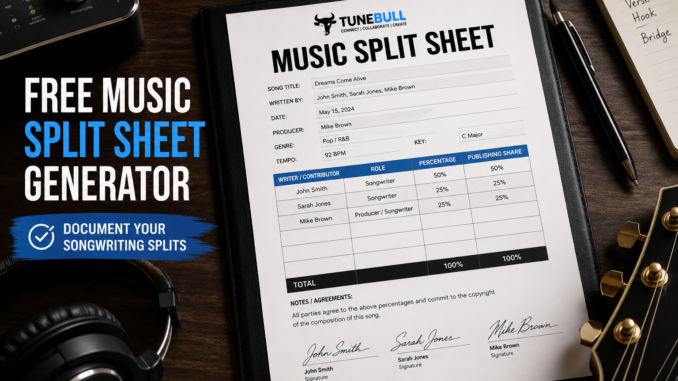
If you collaborate with other artists, producers, or songwriters, there is one document you should consider completing before releasing your song:
A music split sheet. This is how to create a Free Music Split Sheet Generator
A split sheet records who contributed to a song and what percentage of the composition each songwriter owns. It may seem like a small piece of paperwork when you’re in the studio, but getting songwriting splits documented early can help prevent confusion and disputes later.
The good news is that you don’t have to create one from scratch.
TuneBull offers a music split sheet generator that allows musicians to enter their song information, add contributors, assign percentages, and generate a professional split sheet document.
In this guide, we’ll explain what a music split sheet is, why musicians should use one, how songwriting percentages work, and how to generate a music split sheet using TuneBull.
What Is a Music Split Sheet?
A music split sheet is a document used by songwriters and music collaborators to record each contributor’s ownership percentage in a song’s underlying composition.
For example, imagine three people write a song together:
Artist A — 50%
Songwriter B — 25%
Producer C — 25%
Together, the songwriting percentages equal 100%.
The split sheet creates a written record showing what everyone agreed to.
This becomes particularly important if the song eventually generates money through streaming, publishing royalties, performance royalties, synchronization licensing, or other uses.
Without documentation, collaborators may remember the original agreement differently months or years later.
Why Are Music Split Sheets Important?
The best time to discuss song ownership is usually before the song becomes successful.
When a record isn’t generating money, everybody may agree about who contributed what.
Things can change quickly when money enters the picture.
Imagine creating a song with another artist and a producer. Six months later, the record starts gaining traction.
It reaches hundreds of thousands of streams.
A major playlist adds it.
A music supervisor becomes interested in licensing it for television.
Suddenly, determining who owns the composition becomes extremely important.
One collaborator remembers agreeing to 25%.
Another remembers 33%.
Someone else claims an additional songwriting contribution.
This is exactly the type of situation proper documentation can help prevent.
A music split sheet gives collaborators a written record of the ownership percentages they agreed upon.
Who Should Use a Split Sheet?
Split sheets aren’t only for major recording artists.
Independent musicians should consider documenting their songwriting splits whenever multiple people contribute to a composition.
That can include:
- Artists
- Songwriters
- Music producers
- Composers
- Lyricists
- Co-writers
- Musicians who contributed copyrightable songwriting elements
The important question isn’t necessarily what someone’s job title was.
The question is:
Who contributed to the songwriting or composition, and what ownership percentages did everyone agree upon?
Not every person involved in making a recording automatically owns part of the composition. For example, someone may be hired solely as a session musician or engineer under a separate agreement.
When you’re unsure about ownership, publishing, or copyright rights, consider getting advice from a qualified music attorney.
How Do Songwriting Splits Work?
Songwriting ownership is generally represented using percentages.
The total ownership of the composition should equal:
100%.
For example:
Two Songwriters
Songwriter #1 — 50%
Songwriter #2 — 50%
Total: 100%
Or perhaps the collaborators agreed on:
Songwriter #1 — 70%
Songwriter #2 — 30%
Total: 100%
There isn’t a universal rule saying collaborators must divide every song equally.
The appropriate percentages depend on what the collaborators agree to and the circumstances surrounding the creation of the song.
That’s why discussing splits early is so important.
What About Producers?
This is where musicians sometimes become confused.
A producer doesn’t necessarily receive songwriting ownership simply because they produced the recording.
However, producers sometimes make creative contributions to the underlying composition and negotiate songwriting ownership as part of their agreement.
For example, a producer might help create the chord progression, melody, structure, or other compositional elements.
The collaborators might agree to:
Artist/Songwriter — 50%
Co-writer — 25%
Producer — 25%
Or they might agree to something completely different.
There is no substitute for actually discussing the ownership and documenting what everyone agrees upon.
Never assume everyone remembers the deal the same way you do.
How to Generate a Music Split Sheet Using TuneBull
TuneBull makes the process much easier with its Split Sheet Generator.
Instead of opening a blank document and trying to figure out what information belongs on a split sheet, you can enter the relevant song and contributor information into the generator.
Here’s the basic process.
Step 1: Go to TuneBull
Visit TuneBull.com and access the Split Sheet Generator through TuneBull’s music tools.
TuneBull is an online platform built for artists, producers, musicians, and other music creators.
Step 2: Enter Your Song Information
Start by entering the requested information about the song.
Make sure the song title and other information are accurate.
Consistency matters in the music industry, especially when information eventually appears across distributors, performing rights organizations, publishing administrators, copyright registrations, and other databases.
Step 3: Add Each Contributor
Next, add the people who contributed to the composition.
Depending on your collaboration, this might include the:
Artist
Producer
Songwriter
Composer
Lyricist
Co-writer
Enter the requested information carefully.
Don’t rush through this part.
The purpose of the document is to create a clear record of who participated in the composition.
Step 4: Assign Each Contributor’s Percentage
Now enter the ownership percentage agreed upon for each contributor.
For example:
John Smith — Songwriter — 50%
Jane Doe — Songwriter — 25%
Mike Producer — Producer/Writer — 25%
Total — 100%
Before finalizing the split sheet, make sure everyone understands and agrees to the percentages.
A split sheet shouldn’t be used to surprise collaborators with percentages they never discussed.
Have the conversation first. Document the agreement second.
Step 5: Verify the Splits
Check your numbers.
The songwriting ownership percentages should add up to:
100%.
This sounds obvious, but incorrect percentages can create unnecessary problems when songs are registered or royalties are being administered.
Review every contributor and percentage before generating the final document.
Step 6: Generate Your Split Sheet
Once you’ve entered the song information, contributors, roles, and percentages, use TuneBull to generate your split sheet document.
You now have a much cleaner record of the agreed songwriting splits than relying on text messages, conversations, or someone’s memory.
When Should You Complete a Split Sheet?
Ideally, handle songwriting splits as soon as possible after the song is written.
Don’t wait until release day.
And definitely don’t wait until the song starts making money.
A productive studio session can be exciting. Everyone finishes the song, listens to the final version, and starts discussing releasing it.
Nobody wants to ruin the moment by talking about percentages.
But five minutes of uncomfortable business conversation today could prevent months of disagreement later.
Make split sheets part of your normal workflow.
Finish the song.
Discuss the splits.
Document the agreement.
Then move forward.
Don’t Rely on Text Messages Alone
You might think:
“We already discussed the percentages in our group chat.”
That’s better than having absolutely no record, but important music business agreements shouldn’t be scattered across text messages, DMs, emails, and conversations.
Create an organized system.
Keep your split sheet together with your other documentation for the song.
That might include:
- Producer agreements
- Beat licenses
- Collaboration agreements
- Work-for-hire agreements
- Session musician releases
- Copyright information
- ISRC information
- Distribution information
- Publishing registrations
- Master recording information
Think of every song as an asset.
The more organized your documentation is, the easier that asset becomes to manage.
Split Sheets and Music Royalties
A split sheet doesn’t collect royalties for you.
This is an important distinction.
The split sheet documents the ownership agreement between the contributors.
You’ll still need to properly register and administer your music with the appropriate organizations and services.
Depending on your situation, that can involve performing rights organizations, mechanical royalty collection, publishing administration, distributors, SoundExchange, and other royalty sources.
Think of the split sheet as the starting point.
Before everyone can properly register their ownership, everyone needs to know:
Who owns what?
That’s the question the split sheet helps answer.
Keep Your Music Business Organized From Day One
Independent artists often spend thousands of hours improving their music while spending almost no time organizing the business surrounding it.
That’s a mistake.
You don’t need to become a music attorney or accountant.
But you should understand the fundamentals of:
Copyright.
Publishing.
Royalties.
Songwriting ownership.
Master ownership.
Contracts.
Metadata.
And split sheets.
Your music isn’t only art.
Once it’s released commercially, it’s also intellectual property that can potentially generate income for years.
Treat it accordingly.
Generate Your Music Split Sheet With TuneBull
If you’ve recently collaborated on a song, don’t leave the songwriting percentages undocumented.
Have the conversation with your collaborators, agree on the percentages, and put the agreement in writing.
TuneBull’s Split Sheet Generator makes it easier to document your song information, contributors, roles, and ownership percentages in one place.
Whether you’re an independent artist, producer, songwriter, or composer, making split sheets part of your normal recording process can help keep your music business organized.
Create your music split sheet with TuneBull today.
Visit TuneBull.com and use the Split Sheet Generator under the tools section to document your next collaboration.
Because the best time to figure out who owns what isn’t after the song becomes successful.
It’s before.
Disclaimer: This article is provided for general educational and informational purposes and is not legal, tax, accounting, or financial advice. A split sheet may not address every legal or contractual issue involved in a music collaboration. Consult a qualified attorney regarding your specific situation.